

Introduction
Surfing swimwear has one job that beach swimwear does not: it has to stay on you while the water pulls at it. Fixed-back tops, sewn-in drawstrings, and a snug (not tight) fit cover the main decisions for most recreational water-sport days — no premium price tag required. This guide covers women's surfing swimwear for surfing, paddleboarding, and snorkeling: which styles stay secure, how to check UPF and fabric claims on a listing, and how to test fit before you buy. It sits inside our wider occasion-based series — the Bikini by Occasion & Environment guide (coming soon) ties these activity guides together.
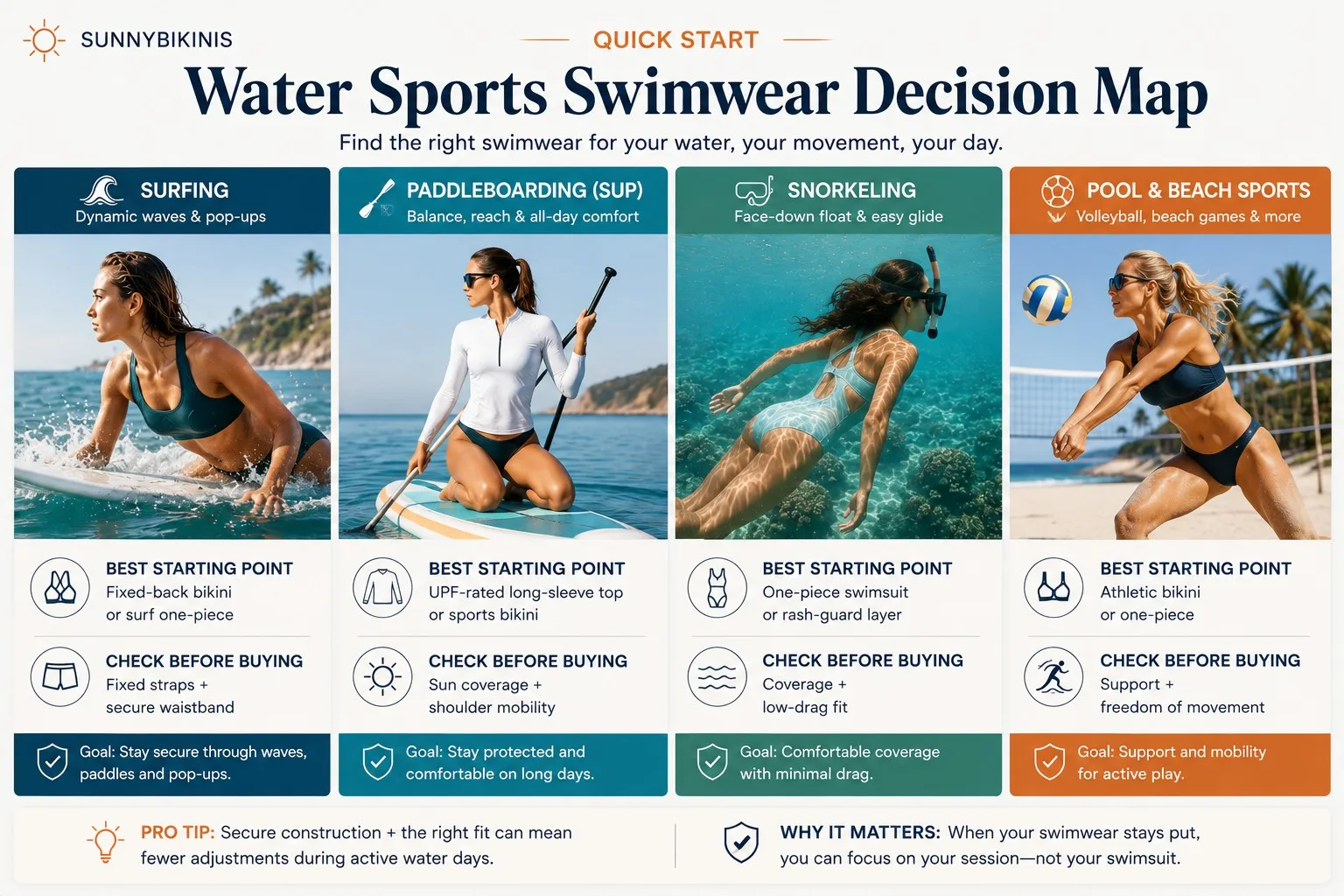
Quick Start: Which Water Sport Are You Dressing For?
Match your activity to a starting point, then confirm the details on the product page before you order. One row usually answers the day.
| Activity | Best starting point | Check before buying |
|---|---|---|
| Surfing | Fixed-back bikini or surf one-piece | Fixed straps + secure waistband |
| Paddleboarding | UPF top + secure bottom | Sun coverage + shoulder mobility |
| Snorkeling | One-piece or rash-guard layer | Coverage + low-drag fit |
| Pool & beach sports | Athletic bikini or one-piece | Support + movement |
Quick decision — you can stop here: if one row matches your plan, compare listings in that direction now. Keep reading for the details behind each choice, or for fit and fabric checks.
The Performance Formula: Security, Movement, Sun, Comfort
For active water days, think in four checks: Security → Movement → Sun Coverage → Comfort. Every style decision in this guide comes back to these four.
- Security — fixed straps and a secure waistband help reduce shifting.
- Movement — shoulders and hips move freely through paddling and pop-ups.
- Sun — verify a stated UPF rating where you need it; do not assume it.
- Comfort — no digging, rubbing, or hardware pressure after an hour in the water.
A suit that passes all four is a stronger starting point for most recreational sessions. A suit that fails one — say, a tie-neck top that shifts when you paddle — is a distraction you will notice by the second wave.
What Is the Best Swimsuit for Surfing?
There is no single best suit for surfing — three types work, and the right one depends on your coverage preference and water temperature: a fixed-back bikini, a one-piece surf suit, or a long-sleeve rash guard set. Each solves a different part of the surf day, so start with the coverage you want, then check the construction. For maximum coverage, start with a surf one-piece; for mobility in warm water, choose a fixed-back bikini; for added arm coverage, add a rash guard.
The three directions:
| Type | Coverage | Best for | Trade-off |
|---|---|---|---|
| Fixed-back bikini | Bust + hips; midriff exposed | Warm-water surf, full mobility | Less skin protection |
| One-piece surf suit | Torso and hips in one piece | All-day sessions, staying put | Slower to remove when wet |
| Long-sleeve rash guard set | Arms and torso | Sun and board-rash protection | More fabric, warmer |
A fixed-back bikini behaves like a sports bra: cross-back straps, a snug band, no tie-neck to loosen. A one-piece surf suit removes the gap at the waist, which matters during paddling and pop-ups. A long-sleeve rash guard adds a fabric barrier over the arms — the same barrier that stops board rash, the skin irritation caused by repeated friction from the board, wax, or other surf gear.
For surfing in Hawaii or California, a snug one-piece or fixed-back bikini is the usual call; water temperature and your sun plan decide which. Use the geography as a hint, not a rule. If you want the bikini direction, browse the surf bikinis collection to compare fixed-back options.
What Makes Surfing Swimwear Stay Put?
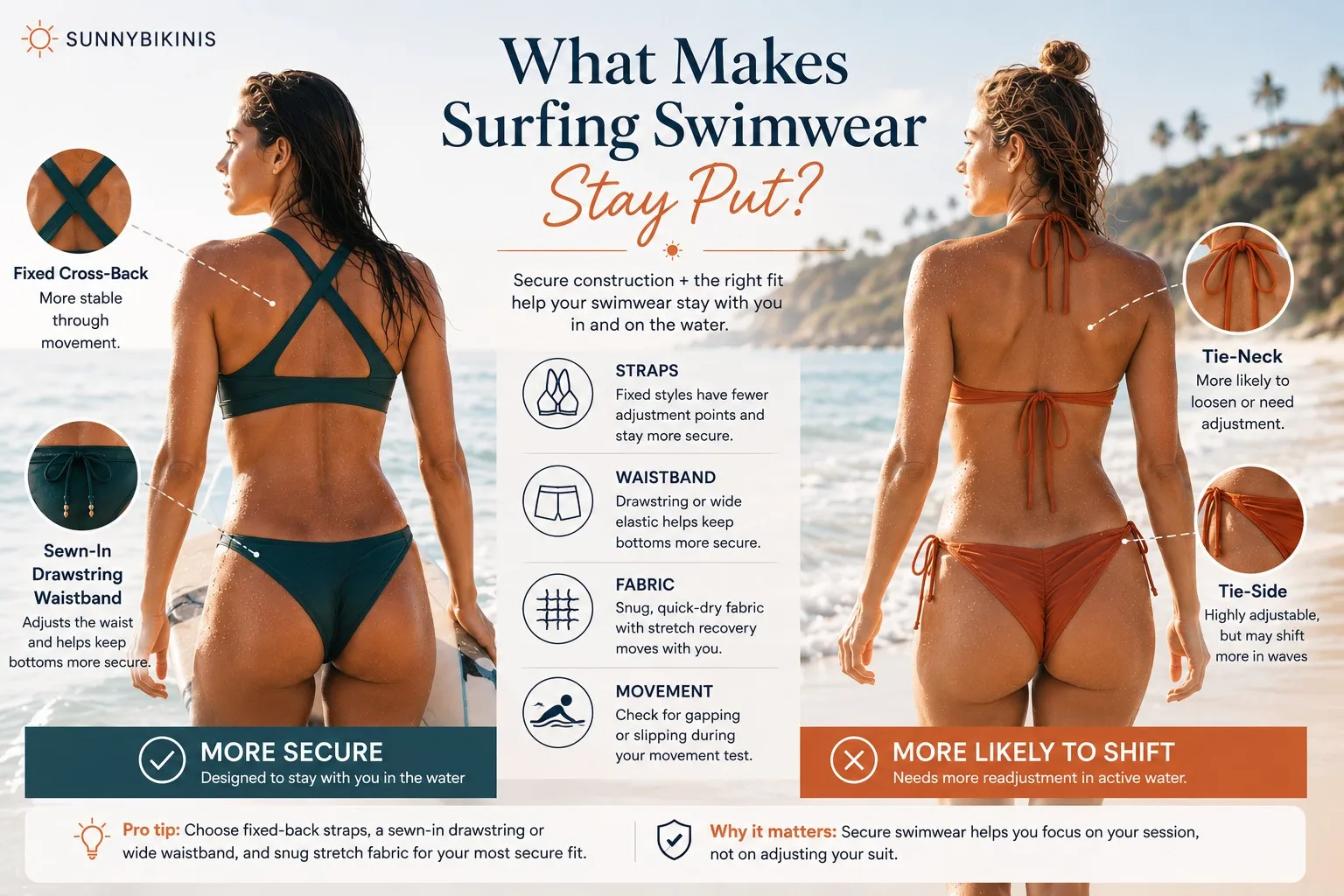
Staying put comes from three structures: fixed straps (cross-back or racerback beats a tie-neck), a sewn-in drawstring at the waist (fabric stretches when wet, and the drawstring helps compensate for changes in fit), and a snug compressive fit with no gap where water can grab the suit.
- Fixed back or cross-back straps = stays on shoulders through pop-ups.
- A sewn-in drawstring = helps the waistband stay secure as the fabric gets wet.
- Snug compressive fabric = no gap where water can grab the suit.
- Tie-side bottoms and halter tie-necks = more likely to shift or loosen in rough water.
Compressive fabric is stretchy fabric that fits close to the body, which reduces the loose pockets that trap water and pull a suit around. It is a construction trait, not a performance promise — a snug suit from any brand can still shift in a big wave.
Avoid for surf days: tie-neck halter tops (especially when you want more bust support), strapless and bandeau styles, side-tie bottoms, and metal hardware that can dig in when you land on a board. If you want athletic silhouettes designed around movement, the sports bikinis collection is a good place to compare.
What Should I Wear for Paddleboarding?
One of paddleboarding's biggest clothing considerations is prolonged sun exposure from above — hours of overhead exposure that pool days do not have. A UPF-rated long-sleeve top or a sports bikini with a wide-waist bottom (plus shorts if you want them) beats "wearing less."
Three things matter on a board: sun coverage (check the listing for a stated UPF rating), free shoulder movement for paddling, and a bottom that stays put when you fall in and climb back on. Falling is normal on a board; a suit that needs adjusting after every remount cuts into the session.
On Florida family beaches, paddleboarding is often a slow, sunny affair — coverage and a stated UPF rating matter more than sporty construction. Use the geography as a hint, not a rule.
| Option | Primary job | Sun coverage | Movement | Best for |
|---|---|---|---|---|
| Rash guard top | Sun + rash protection | High (if rated) | Good | Long, sunny paddles |
| Sports bikini | Secure support | Medium | Best | Warm-water sessions |
| One-piece | Coverage + staying put | Medium-high | Good | All-day on the water |
What Swimwear Works for Snorkeling, Diving Layers & Open-Water Days?
For snorkeling and open-water days, choose a one-piece or rash-guard base layer with full coverage and a low-drag fit — the suit stays close to the body, so it does not flap or gather in the water. On diving days, the swimsuit is usually a base layer rather than the main exposure protection.
The key distinction: for scuba or freediving, water temperature, wetsuit thickness, and thermal protection come from an exposure suit — the swimsuit underneath is a comfort and hygiene layer, not the thing keeping you warm. For snorkeling, where the surface sun is the main risk, a one-piece with coverage or a rash guard layered over a bikini handles both sun and chafe.
- A one-piece stays on the shoulders and covers the torso in one piece.
- A rash guard works as the layer under a wetsuit, reducing friction.
- Snorkeling exposes your back while you float face-down — coverage there matters.
Long-sleeve and high-coverage one-pieces cover the torso without a waist gap, which suits open-water swimming too. Browse the one-piece swimsuits collection for higher-coverage directions.
Rash Guard vs. Swimsuit: Which Do I Need?
A rash guard is an activity-first layer for sun and skin protection; a swimsuit is the garment you swim in. They work together — a rash guard worn over a bikini — or separately, and the right call depends on whether you want full-sleeve coverage or a suit you can wear on its own.
Rash guards earn their name from the "rash," the skin irritation that rubbing sand, boards, and wetsuits cause. A long-sleeve rash guard blocks that friction and adds sun coverage at the same time. A rated rash guard can reduce UV exposure on the skin it covers, but exposed skin still needs sun protection. For the full breakdown of sleeves, closures, and activity checks, see our rash guard and long-sleeve one-piece guide.
Does UPF Matter for Water Sports Swimwear?
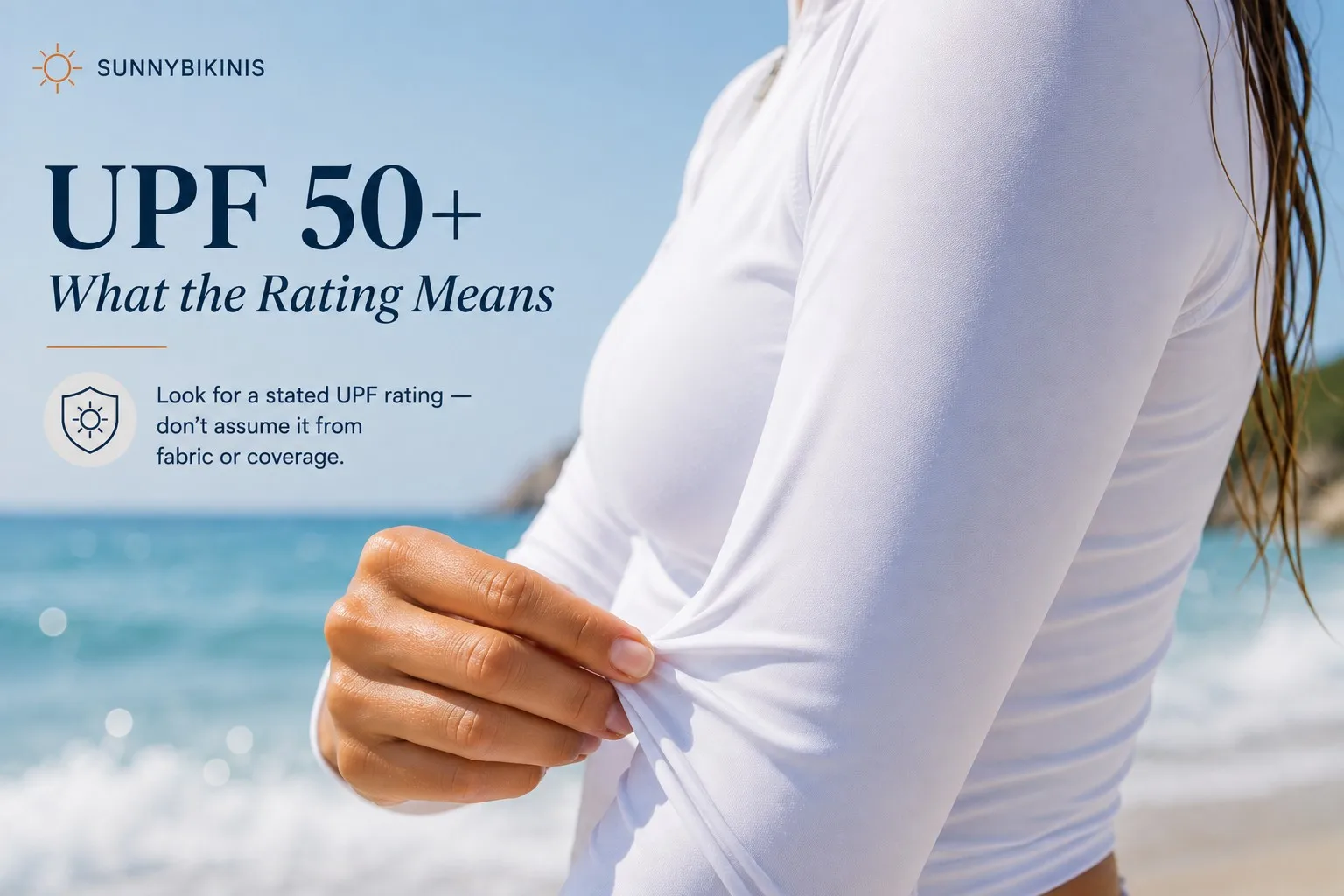
UPF (Ultraviolet Protection Factor) is a tested rating, not a fabric promise — a suit earns UPF only when the product page states it. Long sleeves alone do not give you a rating; the weave, fiber, and treatment do.
| UPF rating | UV blocked | Typical use |
|---|---|---|
| UPF 15–24 (good) | 93–96% | Short, casual exposure |
| UPF 25–39 (very good) | 96–97% | Most beach days |
| UPF 40–50+ (excellent) | 97.5–98% | Surfing, paddling, all-day sun |
The percentages follow the rating math: a UPF N fabric lets roughly 1/N of the UV through, so UPF 30 blocks about 96.7% and UPF 50 blocks about 98%. These rating bands match the guidance from The Skin Cancer Foundation, which rates UPF 30–49 as very good and UPF 50+ as excellent. Use the table as a reading key, not a product promise — the rating on the listing is the number that counts.
To check a listing, find the word "UPF" plus a number, and confirm the rating applies to the suit you are buying rather than a single panel. If the page says "sun protection" without a number, treat it as marketing language. When in doubt, keep sunscreen in your routine and reapply after swimming — a suit covers only the skin it stays on.
Which Fabrics and Construction Features Matter?
Stretch recovery, quick drying, and durability are the three fabric checks that matter most for surf use. Chlorine resistance only matters if the same suit is also used regularly in pools — surfing itself is saltwater.
Stretch recovery is the fabric's ability to spring back after being stretched; it helps a snug suit recover its shape after movement. Fit also depends on pattern, elastic, and construction, so treat recovery as one check among several. Quick-dry fabrics shed water fast, which matters between sessions and for travel. Durability shows up in how the fabric holds color and shape after salt, sun, and sand.
Construction features worth checking on the listing:
- Closure — a front zip opens wide for entry and makes wet removal far easier than a tight pull-on.
- Seams — flat seams reduce friction against the skin during long sessions.
- Pads — removable cups are easier to clean and let you adjust support.
A zip is a practical choice for surf days: it opens wide for entry, and it is far easier to remove when wet. If a suit uses pull-on construction, check how it fits over the shoulders before you commit.
How Should Surfing Swimwear Fit? Try These 5 Checks
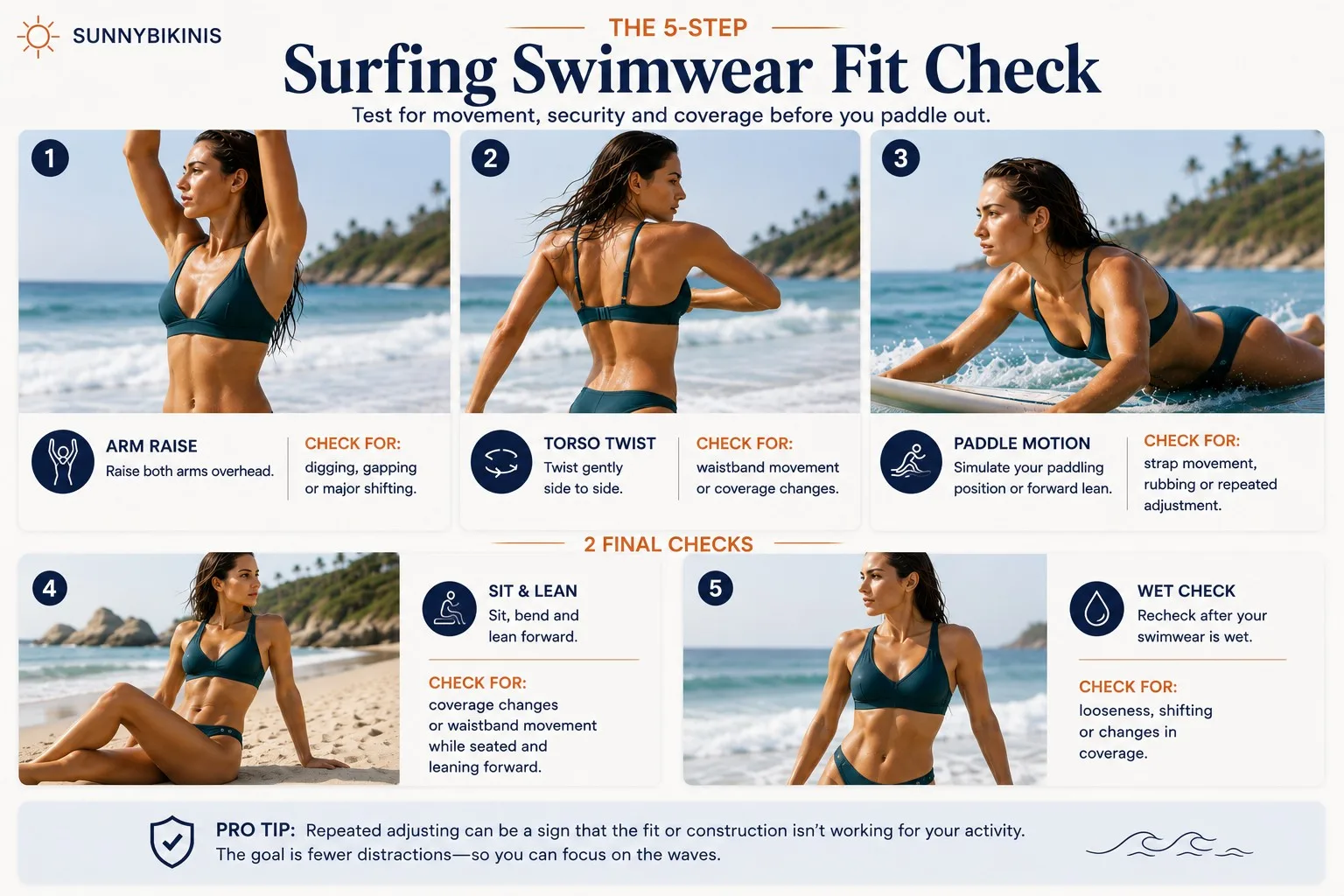
Fit means snug, not tight — and the way to verify it is movement, not the size chart. Run these five checks in the suit before you buy:
- Raise both arms overhead — sleeves and shoulder seams should not bind.
- Twist your torso — the zip or seams should not pull.
- Paddle motion — simulate your paddling position; check for strap movement or repeated adjustment.
- Sit and lean forward — check whether the hem or leg openings shift.
- Wet check — recheck once the suit is wet; if a front zip is available, it beats wrestling a pull-on.
If a suit fits everywhere but rides up at the hem, torso length may be the issue rather than overall size — a longer-torso suit often solves that better than sizing up. For larger busts, over-shoulder straps or a wide band generally provide a more stable support structure than a thin tie; for more coverage, high-waist bottoms or a short over the suit changes the look without changing the structure. Fit preferences vary, so treat these as checks, not guarantees.
Sunnybikinis Picks for Active Water Days
These five Sunnybikinis styles cover surf, paddle, and beach-sport days, priced from $38.88 to $54.99. Each has features associated with a more secure fit — fixed structure, zips, sleeves, or snug waists — and the product page is the final reference for specs and availability.
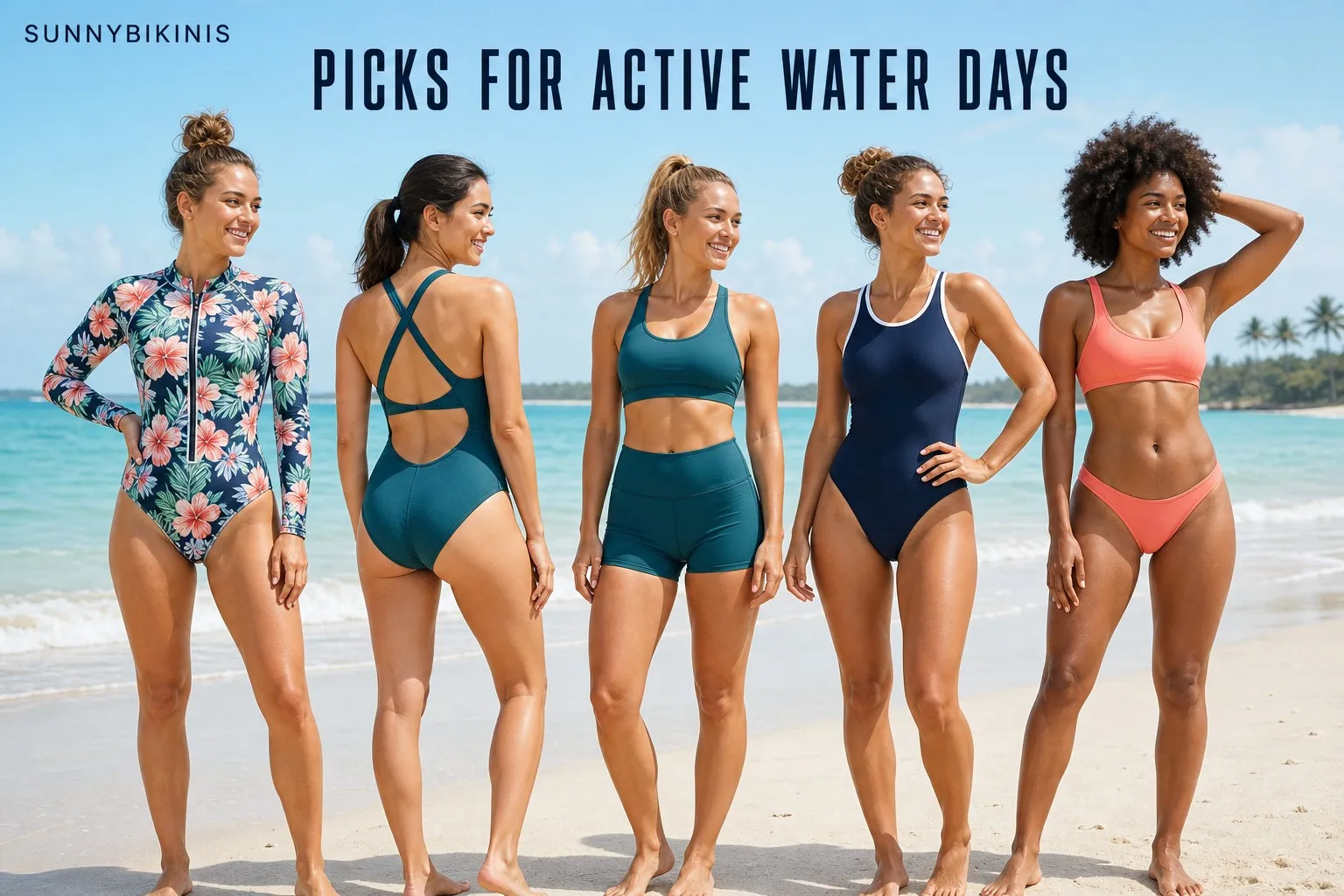
Boho Floral Long Sleeve Surf Rash Guard One Piece Swimsuits — $38.99. A long-sleeve surf rash guard in one piece: sleeves for sun and board-rash coverage, connected body so there is no waist gap. It carries 26 reviews at 5.0 stars; reviewers flag sizing ("take a larger size"), which matches the fit logic above — snug matters, but not restrictive. A strong first stop for surf days.
Boho Floral Long Sleeve Surf Rash Guard One Piece Swimsuits
Long Sleeve Surfing Swimsuit Two-Piece Print Set for Women — $54.99. A surfing two-piece: long-sleeve top plus separate bottoms. The top gives the sleeve coverage of a rash guard while the set keeps mix-and-match freedom — useful if you want sun coverage on top and your own bottom choice below.
Long Sleeve Surfing Swimsuit Two-Piece Print Set for Women
Tropical Print Long-Sleeve Backless High-Cut One-Piece — $38.88. A long-sleeve one-piece with a high-cut leg and open back — coverage through the torso and arms with a fashion edge. Note the backless design means less sun coverage on the back, so pair it with sunscreen there. The listing does not state a UPF rating, so treat it as a coverage style, not a sun-protection claim. Read it as a light-activity pick — resort days or easy paddling — rather than a surf-performance suit.
Tropical Print Long-Sleeve Backless High-Cut One-Piece
Zipper Bikini Set with Boxer Shorts – Sports Swimwear — $46.99. A zip-front sports set with matching boxer shorts: the zip eases wet removal, and the shorts add coverage for beach sports or modest days. A practical pick when you want structure plus extra bottom coverage.
Zipper Bikini Set with Boxer Shorts – Sports Swimwear
Sporty Printed Cross-Back One-Piece Swimsuit — $40.65. A one-piece built around movement: racerback-vest top with supportive cross-back straps and a dynamic print. Cross-back structure is the same fixed-strap logic this guide recommends — straps that stay on the shoulders through paddling and pop-ups. The listing does not state a UPF rating, so treat it as a secure-fit style, not a sun-protection claim.
Sporty Printed Cross-Back One-Piece Swimsuit
Prices and availability come from the live product pages on August 26, 2026. Always use the current product page as the final reference.
How Do I Care for Swimwear After Salt Water or Chlorine?
Rinse in fresh water after salt or pool use, air dry away from heat, and skip fabric softener — salt and chlorine are the biggest enemies of a swimsuit's stretch and color.
- Rinse in fresh water right after salt or pool use.
- Wash gently by hand when the care label recommends it.
- Avoid fabric softener — it coats fibers and reduces stretch.
- Air dry in shade; heat breaks down elastic.
- Do not wring or twist aggressively.
- Rinse sand out of zipper tracks before washing.
A quick freshwater rinse takes seconds and helps reduce salt and chlorine buildup, preserving stretch and color over time. For fabric-specific guidance, follow the care label on your suit — the manufacturer's washing instructions are the reliable reference for that exact fabric blend. These steps take little time and keep the suit ready for the next session.
Sources
- The Inertia — Best Women's Swimsuits for Surfing(dated gear roundup used as a market reference for style directions and stay-put features): https://www.theinertia.com/gear/best-swimsuits-surfing/
- REI Co-op — How to Choose Athletic Swimsuits(activity-based swimsuit framework used as a reference for the performance checks): https://www.rei.com/learn/expert-advice/swimsuits.html
- Billabong — How To Pick the Perfect Bikini for Surfing(style do/don't logic used as a reference for the fixed-strap guidance): https://www.billabong.com/blogs/expert-guides/surf-bikini
- Roxy — Choosing a Surf Bikini - Women's Guide(fit-test and bottoms guidance used as a reference for the five checks): https://www.roxy.com/blogs/expert-guides/choosing-a-surf-bikini-womens-guide
- The Skin Cancer Foundation — Sun Protective Clothing(UPF rating bands, 98% math, and the effects of stretching/wetting on protection; used as the reference for the UPF section): https://www.skincancer.org/skin-cancer-prevention/sun-protection/sun-protective-clothing/
Final Takeaway
Activity decides the suit; the suit decides the session. Pick your water sport first, choose the structure — fixed straps, a secure waist, the right sleeve length — and verify sun claims on the product page before you trust them. Run the five movement checks, treat every listing as the final source, and you will spend less time adjusting and more time in the water.
