

Introduction: Your Beach Towel Can Do More Than Dry You Off
A regular cotton towel does one thing. Functional beach towels solve four problems — cooling, sun protection, privacy, and portability — without adding bulk.
Layer 1: Find Your Beach Towel in 30 Seconds
You do not need to read a gear manual. Pick your priority.
Most shoppers only need these three checks
- Function: Cool down? Block sun? Change privately? Dry off fast?
- Coverage: Hooded? Closed-waist? Full-length? Open?
- Portability: Does it fit in your beach bag? Will it dry before you leave?
QUICK DECISION — You can stop here: If your function and coverage are clear, compare the products below. Keep reading only if you need material details, sizing nuance, or care advice.
Layer 2: Understand Your Beach Towel Options
What Makes a Beach Towel Functional Beyond a Regular Cotton Towel?
Short answer: Functional beach towels use microfiber or cooling polyester — lighter than cotton, faster to dry, and often wearable as a poncho or cover-up.
A regular cotton towel does one job. It dries you — then stays wet for hours, collects sand in every terry loop, and weighs down your bag on the walk back.
A functional beach towel swaps cotton for a different material and a different shape. The result is a towel that dries in minutes instead of hours, shakes sand off instead of trapping it, and in many cases is wearable — so you do not have to juggle a towel, a cover-up, and a changing strategy.

Cotton vs. functional: what changes
One choice, four directions
Sunnybikinis carries four functional towel types, each built around a different beach-day need:
- Cooling towel — thin, portable, instant cool-down
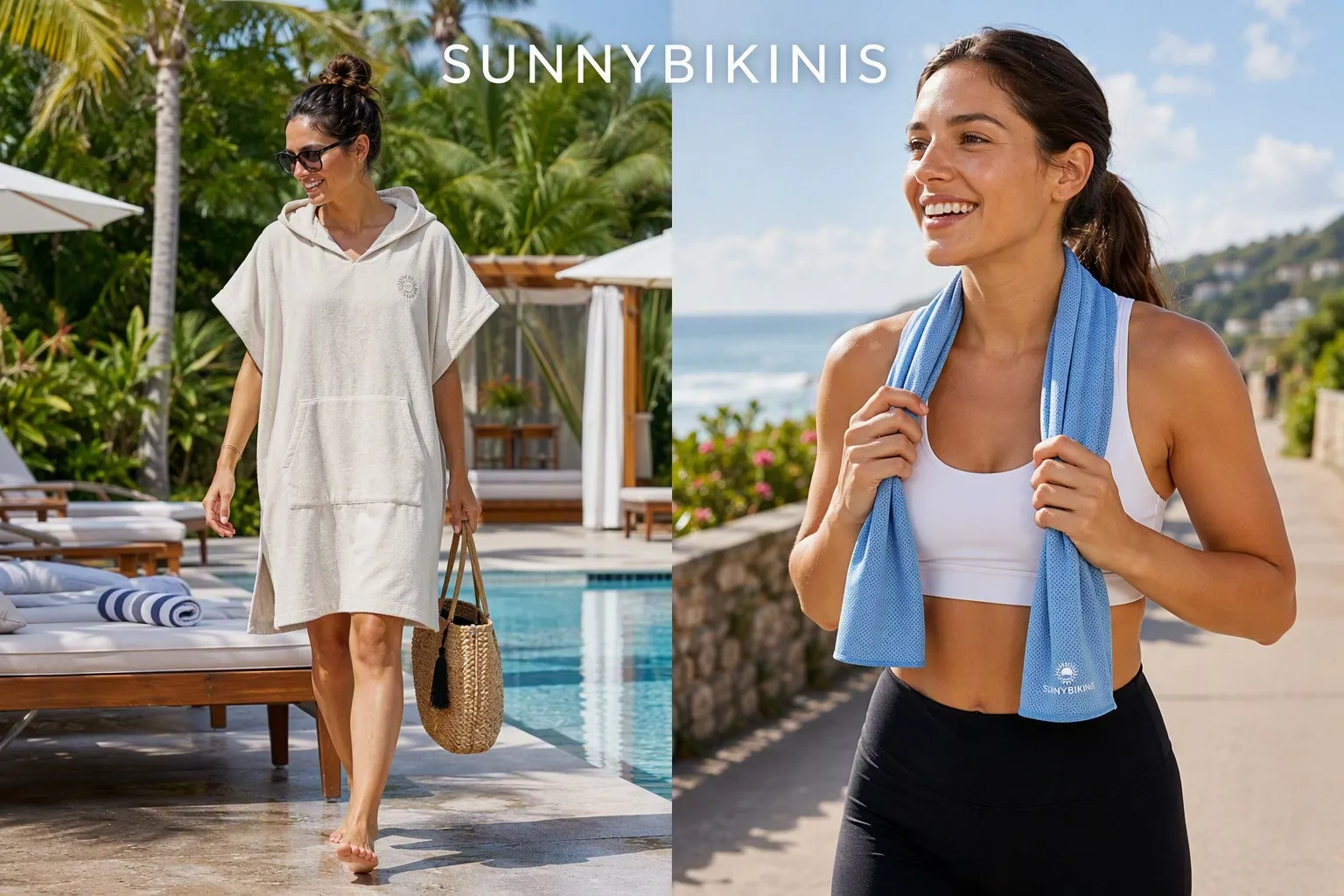
- Hooded poncho — UV coverage, wearable layer, easy cover-up
- Surf robe (hoodie) — quick on/off, post-surf warmth, kangaroo pocket
- Surf robe (closed-waist) — full privacy changing, button-closure design
Compare your priority against these four directions. If you are unsure, start with the hooded poncho — it covers the most use cases.
Cooling Towels: When Staying Cool Matters Most
Short answer: A cooling towel lowers surface temperature through evaporation when wet — best for hot beach days, sports, and sunbathing in direct heat.
You wet it. You wring it. You shake it to activate the cooling. That is the whole routine. A thin polyester fabric releases moisture fast, pulling heat away from your skin as it evaporates.
Sunnybikinis Portable Cooling Towel
What to check before you buy
The thinner fabric cools faster. It also dries out sooner. On a breezy beach, re-wet it every 20–30 minutes. On a still, humid day, the cooling effect lasts longer because evaporation is slower.
If you will use it between volleyball sets or during a run, the silicone case is useful — it keeps the wet towel sealed so your bag stays dry. If you just want to drape it over a lounge chair between dips, the 30 × 100 cm size gives you more fabric.
What the product page says
The listing describes the towel as cooling when wet, quick-dry, and sand-resistant. These are product claims, not laboratory guarantees. The 35 reviews at 4.8 stars suggest that many shoppers are satisfied, but your experience will depend on conditions — wind, humidity, and how often you re-wet.
Portable Cooling Towel with Silicone Case
Hooded Beach Ponchos: Sun Protection That Looks Intentional
Short answer: A hooded beach poncho gives you UV coverage, a wearable layer you do not have to hold, and an easy cover-up for the walk from car to shore.
Sunnybikinis Cooling Hooded Beach Poncho
What to check
The oversized hood is useful for sun protection but adds weight when the fabric is soaked. Gather the fabric behind your neck if it pulls. On a windy beach, the 140 cm length may brush the sand — a slight gather at the waist keeps it off the ground.
The UV claim is third-party verified at 97–98%. That is product-specific evidence, not a blanket guarantee. It means the fabric was tested in lab conditions. Real-world UV exposure depends on wear time, fabric condition, and whether the poncho stays fully covering your skin.
When this works best
Long beach days, family outings, and anywhere you want one layer that does sun protection and a cover-up at the same time. If you are walking from pool to café, the poncho looks intentional over a swimsuit — more put-together than a towel draped over your shoulders.
Cooling Hooded Beach Poncho Cover-Up
Surf Changing Robes: Privacy, Warmth, and a Dry Layer After the Water
Short answer: A surf poncho is an oversized, absorbent robe that lets you change out of a wet suit privately — no towel-dropping, no awkward wrap.
Two Sunnybikinis designs, two changing styles

Surf Poncho Towel Hoodie
The open hoodie design slides on and off fast. The kangaroo pocket holds your phone or keys while you walk back to the car. The oversized hood traps body heat after a cold swim — microfiber insulates when dry.
What to check: Practice pulling your arms inside the poncho to change. The armholes are wide, so the movement is straightforward, but the first time always feels awkward. Do it once at home and the beach will be smooth.
What shoppers notice
18 reviews at 4.9 stars — the absorbency and quick-dry get the most mentions. A few reviewers note that the 78 cm width is generous on most frames but snugger if you are changing while standing on uneven sand. The hoodie style trades a small amount of privacy for speed — fair trade-off if you prioritize quick changes.
Surf Poncho Towel Blue
The closed-waist design buttons under the armpit. This gives you a full privacy tent for changing — no gaps, no exposure. The 90 cm width adds a few more inches of fabric compared to the Hoodie.
What to check: Reach the armpit button with one hand. If it is difficult, button it before pulling the poncho on, then slip your arm through. The closed-waist design takes about 10 seconds longer to change in, but the privacy is complete.
What shoppers notice
17 reviews at 4.8 stars. The privacy design is the main differentiator. A few reviews mention that the button placement works better for some arm lengths than others — if you have limited shoulder mobility, the Hoodie style might be easier.
Choosing between the two
Material Face-Off: Microfiber vs. Cooling Polyester
Short answer: Microfiber absorbs more water and feels softer. Cooling polyester dries faster and cools sooner. Match the material to your main priority — drying off or staying cool.
Sand Resistance: Why Microfiber Shakes Clean Faster
Short answer: Flat-woven microfiber has no terry loops for sand to grip — a quick shake removes most of it. Cotton terry cloth buries sand deep in the loops.
The difference
A cotton towel has thousands of tiny loops. Sand works its way between them and stays. A microfiber towel has a flat, tightly woven surface. Sand sits on top and slides off.
Shake the towel downwind before folding. Let it dry before packing — wet microfiber still clings to fine sand. On a windy day, some sand will always stick. The goal is less sand, not zero sand.
What reviewers confirm
Independent gear reviewers consistently recommend flat-woven microfiber as the top choice for sand resistance. The Sunnybikinis Cooling Towel product page lists "sand-resistant" as a feature — treat this as a product claim based on the fabric structure, not an absolute guarantee.
Size and Fit: One Size Fits Most — What to Compare
Short answer: Most beach towels and ponchos are one-size. Compare the product dimensions against your height and preferred coverage.
Poncho length by height
Cooling towel size
If you prefer more fabric or full coverage, the Hooded Poncho at 140 cm gives you the most length. If you want easy movement for sports or quick changes, the 110 cm surf ponchos feel freer.
Pack It and Go: Portability Across the Line
No product in this line requires a separate beach bag. The Cooling Towel case is the standout here — it seals the wet towel so your dry items stay dry.
Layer 3: Optional Deep Dive — Care, Scenarios, and Product Evidence
When should you continue to Layer 3?
- You need care instructions for microfiber or cooling fabric.
- You want activity-specific picks.
- You are comparing UV or cooling claims across products.
- You are packing for a trip and need a checklist.
- You need product-level evidence before ordering.
Beach Towels by Activity

Sunbathing or lounge day
Pick the Cooling Towel or Hooded Poncho. The Cooling Towel keeps you cool during peak sun. The Hooded Poncho covers shoulders and arms when the UV index is high. If you plan to walk from the sand to a café, the poncho transitions more smoothly.
Surfing or open-water swimming
Pick the Surf Poncho Hoodie. After a cold swim, the oversized hood traps body heat. The kangaroo pocket holds your keys during the walk back. Pull it on, change underneath, and you are dry and dressed in under a minute.
Beach volleyball, running, or paddleboarding
Pick the Cooling Towel at 30 × 80 cm — the smallest, lightest option. Wrap it around your neck between sets. Clip the silicone case to your bag. Re-wet it from your water bottle for a quick refresh.
Family beach day with kids
Pick the Hooded Poncho. The product listing says "kids safe." The oversized cut easily wraps a child as a cover-up. For toddlers, the Cooling Towel at 30 × 80 cm is also easy to handle — no hood to fuss with, just a simple wrap.
Pool-to-bar transition
Pick the Hooded Poncho in black, white, or blue — solid colors look more intentional over a swimsuit than neon. Walk from the lounger to the bar without carrying a wet towel in one hand.
Warmth and Post-Swim Comfort
Short answer: Microfiber insulates when dry — useful after a cold swim or when the breeze picks up. Lighter fabrics dry faster but hold less warmth.
When warmth matters
After an ocean swim in cool water, your body temperature drops fast. A dry microfiber poncho traps a layer of warm air against your skin. The hood on the Surf Poncho Hoodie adds extra insulation around your head and neck — the area where you lose the most heat.
Match the fabric to your water
A lighter fabric dries faster — good on a warm day. A heavier fabric insulates longer — good in cool wind. Check how the poncho feels when dry, not just when you first pull it on.
Kids and Family Use
The Hooded Poncho listing states "kids safe." The oversized cut fits a child easily — roll the sleeves and hem if needed. The hood adds sun protection for the neck and scalp.
One-size ponchos will be long on small children. The Cooling Towel at 30 × 80 cm is a simpler alternative for toddlers — it wraps, dries, and packs small. No buttons, no hood, no adjustments.
If you are packing for a family, one Cooling Towel per adult and one Hooded Poncho to share with kids covers the bases without overpacking.
How to Care for Microfiber and Cooling Towels

If your cooling towel stops feeling cool, it probably has residue buildup from sunscreen, salt, or fabric softener. Wash it with a small amount of mild detergent, rinse thoroughly, and air dry. The cooling effect should return.
The silicone case on the Cooling Towel is dishwasher-safe. If sand or sunscreen gum up the inside, run it through a cycle and let it air dry.
Follow the product page and garment label for any product-specific instructions. Do not assume two microfiber products have identical care requirements.
Before Ordering: Product-Page Checklist

- Confirm material — microfiber or cooling polyester?
- Check the length measurement against your height
- UV claim: verify the listing says "third-party verified"
- Cooling claim: it is a product claim, not a temperature guarantee
- Closure type: open poncho, closed-waist button, or none — which is easier for you?
- Silicone case included with the Cooling Towel? Confirmed on the product page
- Color: check the current availability for the exact shade you want
When Trying It On or Planning the Day
- Wet the towel and check the cooling feel — does it activate within seconds?
- Practice changing inside the poncho — reach the armholes, check the button, confirm coverage
- Walk a few steps with the full-length poncho — does the hem drag?
- Shake it after laying on sand — does most sand release with one shake?
- Sit down — does the poncho bunch or pull?
- Add the bag or tote you will carry — does the poncho pocket or silicone case clip work with your setup?
The goal is not perfection. The goal is knowing how the towel behaves before you are on a windy beach with sand in your bag and no backup plan.
Sunnybikinis Beach Towels: What the Listings Actually Say
Always use the individual product page and current images as the final reference. Product pages can change, and colors or sizes may vary by variant.
Portable Cooling Towel with Silicone Case
Listed as 100% polyester, 120GMS thin, three sizes, ten color options, and a silicone carrying case. Product page claims: cooling when wet, quick-dry, sand-resistant. 35 reviews at 4.8 stars. The silicone case is dishwasher-safe per the listing.
Cooling Hooded Beach Poncho Cover-Up
Listed as microfiber (polyester + spandex), 60 × 140 cm, nine color options, one size. Product page claims: cooling (~15°C drop when wet), UV protection 97–98% (third-party verified), 4-in-1 design. 18 reviews at 5.0 stars. The listing states "kids safe."
Surf Poncho Towel Hoodie
Listed as 100% microfiber, 78 × 110 cm, four neutral color options. Features: kangaroo pocket, oversized hood, unisex, one size fits most. 18 reviews at 4.9 stars. The listing describes it as a 3-in-1 towel, robe, and changing poncho.
Surf Poncho Towel Blue
Listed as microfiber fabric, 90 × 110 cm, one color option (Blue). Features: closed-waist design, button under armpit, ultra-absorbent, unisex, one size fits most. 17 reviews at 4.8 stars. The button closure is the key differentiator from the Hoodie.
FAQ: Beach Towels and Changing Ponchos
What is a cooling towel and how does it work?
A cooling towel is a thin polyester fabric that cools your skin through evaporation. Wet it, wring it until it stops dripping, and shake it to activate air flow. As the water evaporates, it pulls heat from your skin. Re-wet it every 20–30 minutes on a dry day, less often in humidity. It does not need a refrigerator or ice.
What is the difference between a cooling poncho and a surf poncho?
A cooling poncho (Hooded Poncho) prioritizes UV protection and sun coverage with a lightweight fabric that activates a cooling sensation when wet. A surf poncho prioritizes absorbency, warmth, and private changing with thicker microfiber. Pick the Hooded Poncho for sun and coverage. Pick a Surf Poncho for post-swim changing and warmth.
Can I use a surf poncho to change in public?
Yes. Both Sunnybikinis surf ponchos are designed for discrete changing. The Surf Poncho Hoodie uses wide armholes for quick on/off. The Surf Poncho Blue adds a closed-waist button for full-coverage privacy. Practice once at home before using it at a busy beach.
Are microfiber towels better than cotton for the beach?
For most beach days, yes. Microfiber dries faster, weighs less, packs smaller, and shakes sand off more easily than cotton terry cloth. Cotton is softer against the skin and cheaper. If you prioritize dry time, portability, and sand resistance, choose microfiber. If you prioritize softness and do not mind the bulk, cotton is fine.
Do cooling and microfiber towels actually repel sand?
Flat-woven microfiber and cooling polyester shed sand better than cotton because they lack the terry loops that trap sand. A quick downwind shake removes most sand. Wet fabric still clings to fine sand — let it dry before folding. The product claims "sand-resistant," not "sand-proof."
Is one size enough for most body types?
The ponchos are one-size with generous measurements (78–90 cm width, 110–140 cm length). They fit most adults comfortably for changing and coverage. If you are over 5'10", the 140 cm Hooded Poncho gives more length. If you prefer more width, the Surf Poncho Blue at 90 cm is the widest option.
Does the hooded poncho provide real UV protection?
The Cooling Hooded Beach Poncho product page states UV protection of 97–98%, third-party verified. This means the fabric was tested in lab conditions and blocked that percentage of UV rays. Real-world protection depends on how fully the poncho covers your skin and how long you wear it. Treat the third-party verification as product evidence, not a blanket sun-safety promise.
How do I wash and care for these towels?
Rinse in fresh water after salt or chlorine exposure. Machine wash cold on a gentle cycle. Never use fabric softener — it coats the fibers and ruins absorbency. Air dry or tumble dry on low. Store dry. The Cooling Towel silicone case is dishwasher-safe. Follow the individual product care label for any exceptions.
Can kids use these beach towels and ponchos?
Yes. The Hooded Poncho listing says "kids safe." The oversized cut fits a child as a cover-up or towel wrap. For toddlers, the Cooling Towel at 30 × 80 cm is a manageable size — simple to wrap and carry. One-size ponchos will be long on small children; roll the sleeves and hem.
0 comments